
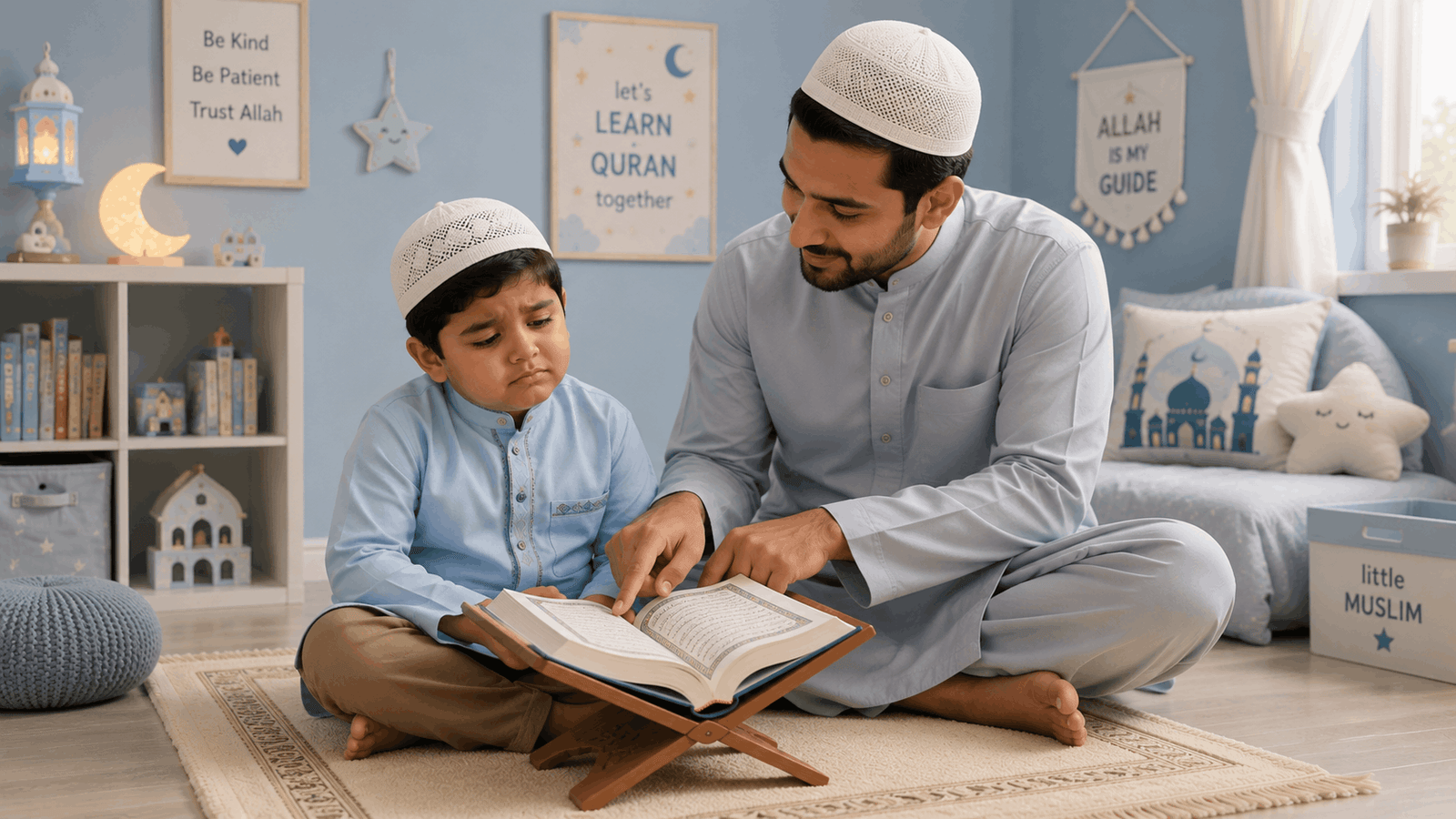
“My child keeps forgetting the surah I taught yesterday.”
“Why doesn’t my son enjoy Qur’an classes?”
“Should I make my daughter repeat the same ayah until she gets it right?”
If you’ve ever asked these questions, you’re not alone.
Every Muslim parent dreams of raising a child who loves the Qur’an, understands Islam, and grows into a confident Muslim. But in that sincere desire, many parents unknowingly fall into a common trap: focusing so heavily on memorisation that they forget about the child’s emotional connection to learning.
Ironically, the more we force children to memorise the Qur’an, the less likely they may be to love it.
Modern child development research offers fascinating insights into why this happens—and more importantly, what parents can do instead.
The Science of Learning: Why Pressure Doesn’t Work
Psychologists have spent decades studying how children learn best.
One of the most influential theories in education is Self-Determination Theory, developed by psychologists Richard Ryan and Edward Deci. Their research found that children learn more effectively when they experience:
- Autonomy (a sense of choice)
- Competence (feeling capable)
- Relatedness (feeling connected and supported)
When learning becomes associated with pressure, criticism, or fear of mistakes, motivation shifts from internal desire to external compliance.
In simple terms:
A child who memorises because they love learning Islam is likely to continue learning for life.
A child who memorises only to avoid punishment or disappointment may stop engaging once the pressure disappears.
Research consistently shows that intrinsic motivation leads to deeper learning, stronger retention, and greater long-term commitment.
What Happens Inside a Child’s Brain?
Neuroscience tells us that emotions play a powerful role in learning.
When children feel safe, encouraged, and curious, their brains release chemicals that support memory formation and attention.
However, chronic stress and anxiety can interfere with the brain’s ability to encode and retrieve information. Studies on childhood learning have shown that excessive pressure can reduce working memory performance and impair learning outcomes.
This explains something many parents observe:
The harder they push, the more the child seems to forget. The problem isn’t usually intelligence. It’s often emotional overload.
Children Learn Through Meaning, Not Repetition Alone
Many parents assume that repeating verses hundreds of times guarantees memorisation.
While repetition helps, developmental psychologists have found that children remember information better when it is connected to meaning, emotion, stories, and real-life experiences.
Think about it:
Most children can remember details from their favourite cartoons, games, and stories for years. Why? Because those experiences engage their emotions and imagination.
The same principle applies to Islamic learning. When children understand:
- Who Allah (SWT) is
- Why a Surah was revealed
- What the words mean
- How the lesson applies to their lives
memorisation becomes much easier and more enjoyable.
The Prophetic Method Was Never About Pressure
The teaching style of Prophet Muhammad ﷺ was remarkably aligned with what modern psychology now recommends.
He taught with patience. He taught gradually. He considered the developmental stage of the learner.
The Prophet ﷺ said:
“Make things easy and do not make them difficult. Give glad tidings and do not drive people away.”
(Sahih al-Bukhari and Sahih Muslim)
Notice the emphasis. Not merely teaching. But teaching in a way that attracts hearts. The goal was never information alone. The goal was transformation.
What the Qur’an Teaches About Gradual Learning
Allah (SWT) سبحانه وتعالى revealed the Qur’an over approximately 23 years. This gradual revelation itself teaches an important lesson.
Allah (SWT) says:
“And the disbelievers say, ‘Why was the Qur’an not revealed to him all at once?’ Thus [it is] that We may strengthen thereby your heart.”
(Qur’an 25:32)
If Allah (SWT) chose gradual learning even for the greatest generation, why do we expect children to absorb large amounts of information instantly?
Islam values consistency over intensity. Small daily steps often produce stronger outcomes than overwhelming bursts of effort.
The Hidden Cost of Forced Memorisation
When children experience Qur’an learning as a constant battle, several risks emerge:
- Reduced Love for Islamic Learning
Children may begin associating Islam with correction rather than connection.
- Performance Anxiety
Fear of making mistakes can make recitation stressful rather than rewarding.
- Shallow Retention
Information memorised under pressure is often forgotten quickly.
- Weak Islamic Identity
A child may know many verses but struggle to understand their meaning or relevance. The objective isn’t simply producing children who can recite. The objective is to raise children who carry Islam in their hearts.
What Works Better? Building Love Before Memorisation
Research on early childhood education consistently shows that engagement precedes mastery. Before expecting children to memorise large portions of the Qur’an, focus on helping them:
- Love Allah (SWT)
- Enjoy learning Islam
- Build positive habits
- Feel successful
- Understand basic meanings
- Connect with other Muslim children
Once these foundations are in place, memorisation becomes significantly easier.
A Practical Approach for Modern Muslim Parents
Instead of asking:
“How many surahs has my child memorised?”
Try asking:
- Does my child enjoy Islamic learning?
- Does my child look forward to classes?
- Does my child understand what they are learning?
- Is Islam becoming part of their identity?
These questions often predict long-term success better than memorising numbers alone.
How Happy Muslims Boat Supports Healthy Islamic Learning
At Happy Muslims Boat, we believe children learn best when faith is experienced with joy, understanding, and connection.
That’s why the Pearl Kids Bundle Program is designed around principles supported by both Islamic tradition and modern child development research.
Rather than relying solely on memorisation, children are immersed in an engaging Islamic environment that helps them build lasting relationships with their faith.
Weekly Online Group Meetings
Children learn alongside other Muslim kids in a positive and encouraging environment.
Research shows that peer learning increases motivation, participation, and long-term engagement.
These weekly gatherings help children:
- Feel part of a Muslim community
- Develop confidence
- Build friendships
- Stay motivated in their Islamic journey
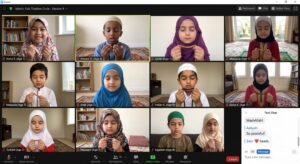
Interactive Dhikr Classes
Regular dhikr strengthens a child’s connection with Allah (SWT) while nurturing emotional well-being. Children learn meaningful remembrance of Allah (SWT) in an age-appropriate and enjoyable way.
Over time, these practices become lifelong habits rather than forced routines.
Understanding Before Memorisation
The Pearl Kids Bundle helps children understand Islamic concepts through stories, activities, discussion, and practical application. When understanding grows, memorisation naturally becomes easier and more meaningful.
Consistent, Gentle Learning
Rather than overwhelming children with unrealistic expectations, the program focuses on steady progress that supports healthy spiritual development. This aligns beautifully with the Prophetic principle that the most beloved deeds to Allah (SWT) are those done consistently, even if small.
Raising Children Who Love the Qur’an
Every parent wants their child to succeed. But success in Islamic education is not measured solely by how much a child can recite today. True success is raising a child who still loves the Qur’an at 15, 25, and 50 years old.
A child who turns to Allah (SWT) during difficulty.
A child who finds comfort in dhikr.
A child whose heart remains connected to Islam long after childhood.
That journey begins not with pressure, but with love. Not with fear, but with connection. Not with forcing memorisation, but with nurturing a lifelong relationship with Allah (SWT) and His Book.
At Happy Muslims Boat, our mission is to help families build exactly that foundation through the Pearl Kids Bundle, weekly online group meetings, and engaging dhikr classes that help children develop strong Islamic roots – one joyful step at a time.