“The best among you are those who have the best manners and character.”
— Prophet Muhammad ﷺ (Sahih al-Bukhari)
Raising Children in a Different World
Parenting has never been easy. But raising children in the 21st century presents challenges unlike any previous generation has faced.
Today’s children are growing up in a world of constant notifications, social media pressures, academic competition, information overload, and increasing mental health concerns. Many Muslim parents find themselves asking:
“How do I ensure my child remains connected to Islam while also thriving emotionally and socially?”
The answer may lie in combining two powerful frameworks: Islamic Tarbiyah and Emotional Intelligence (EQ).
For centuries, Islam has provided a complete model for nurturing human beings. Interestingly, modern psychology is now discovering what the Quran and Sunnah taught more than 1,400 years ago: emotionally healthy children become spiritually stronger, socially competent, and mentally resilient adults.
The future of Islamic parenting is not choosing between religious education and emotional development. It is integrating both.
What is Tarbiyah?
The Arabic word Tarbiyah comes from the root ر-ب-ب (Ra-Ba-Ba), which relates to nurturing, developing, cultivating, and helping something reach its full potential.
Tarbiyah is far more than teaching children halal and haram.
It involves nurturing:
- Faith (Iman)
- Character (Akhlaq)
- Knowledge (Ilm)
- Emotional well-being
- Social responsibility
- Relationship with Allah (SWT)
Allah (SWT) says in the Quran:
“And lower to them the wing of humility out of mercy and say, ‘My Lord, have mercy upon them as they brought me up [rabbayani] when I was small.'”
(Quran 17:24)
Notice that the Quran uses the concept of nurturing and raising with mercy, not merely instructing. True Tarbiyah develops both the heart and the mind.
The Mental Health Crisis Among Children
Before discussing emotional intelligence, it is important to understand why it matters.
According to the World Health Organization (WHO):
- Approximately 1 in 7 adolescents globally experiences a mental health disorder.
- Depression, anxiety, and behavioural disorders are among the leading causes of illness among young people.
Research published in The Lancet Psychiatry has consistently shown rising rates of anxiety and emotional distress among children and adolescents worldwide.
Meanwhile, studies from the Journal of Child Psychology and Psychiatry suggest that emotional regulation skills developed during childhood strongly predict future academic success, relationship quality, and psychological well-being.
In simple terms, children who learn to understand and manage emotions tend to perform better in nearly every area of life. The remarkable thing is that Islam has always emphasized emotional mastery.
What is Emotional Intelligence?
Psychologist Daniel Goleman popularized Emotional Intelligence (EQ) as the ability to:
- Recognize emotions
- Understand emotions
- Manage emotions
- Show empathy
- Build healthy relationships
Many experts now believe EQ predicts life success as much as, or sometimes more than, IQ.
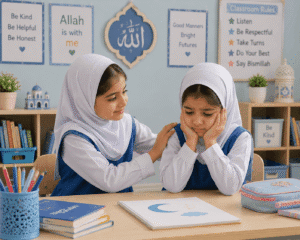
A 2011 meta-analysis involving over 200 studies found that social and emotional learning programs significantly improved:
- Academic performance
- Social behaviour
- Emotional regulation, and
- Mental health outcomes
Children with strong emotional intelligence are more likely to:
- Handle stress effectively
- Avoid risky behaviours
- Develop healthier friendships
- Resolve conflicts peacefully
- Show empathy toward others
Sounds familiar? These are exactly the qualities Islam seeks to cultivate.
Emotional Intelligence Was Modelled by the Prophet ﷺ
The Prophet Muhammad ﷺ was the greatest teacher of emotional intelligence.
He validated emotions
When a child feels sad, angry, embarrassed, or afraid, many adults rush to dismiss the feeling:
“Don’t cry.”
“Stop being angry.”
“You’re overreacting.”
The Prophet ﷺ did the opposite.
When his son Ibrahim passed away, tears flowed from his eyes. When questioned, he replied:
“The eyes shed tears, and the heart grieves, but we only say what pleases our Lord.”
(Sahih al-Bukhari)
This teaches children a profound lesson: Emotions are not sinful. How we respond to them matters.
He taught emotional regulation
The Prophet ﷺ said:
“The strong person is not the one who can overpower others, but the one who controls himself when angry.”
(Sahih al-Bukhari)
Modern neuroscience supports this teaching.
Research from Harvard Medical School and multiple psychological studies shows that children who develop self-regulation skills experience:
- Better academic outcomes
- Stronger relationships
- Improved mental health
- Lower rates of substance abuse
Islam taught emotional self-control centuries before psychologists began studying executive functioning.
He practised empathy
Empathy is a cornerstone of emotional intelligence.
The Prophet ﷺ shortened prayers when he heard a baby crying because he understood the mother’s distress. He carried children while praying. He listened attentively. He comforted those who were grieving. He demonstrated that strength includes compassion.
Why Fear-Based Parenting Often Fails
Many Muslim parents grew up hearing:
“Do it because I said so.”
“Don’t question.”
“Just obey.”
While obedience has a place, research consistently shows that excessive authoritarian parenting can create:
- Anxiety
- Low self-esteem
- Reduced emotional openness
- Weaker parent-child relationships
Studies published in Developmental Psychology indicate that children thrive best when parents combine clear expectations with warmth, empathy, and responsiveness.
Islamic parenting is not authoritarian domination. It is compassionate leadership.
Allah (SWT) describes the Prophet ﷺ:
“It is by the mercy of Allah that you were gentle with them. Had you been harsh and hard-hearted, they would have dispersed from around you.”
(Quran 3:159)
If gentleness was essential in guiding adults, how much more important is it when guiding children?
Building Emotional Intelligence Through Islamic Tarbiyah
- Teach Emotional Vocabulary
Many children cannot explain what they feel. Instead of labelling every emotion as “good” or “bad,” help children identify:
- Frustrated
- Nervous
- Disappointed
- Excited
- Lonely
- Grateful
The more accurately children can identify emotions, the better they can regulate them.
- Connect Emotions to Allah (SWT)
- When children feel worried: Teach them to make dua.
- When they feel grateful: Teach Alhamdulillah.
- When they feel afraid: Teach reliance on Allah (SWT).
- When they feel guilty: Teach repentance and hope.
Islam transforms emotional experiences into opportunities for spiritual growth.
- Use Stories of the Prophets
The Quran contains powerful examples of emotional intelligence.
Prophet Yaqub (AS)
He experienced grief yet remained patient.
Prophet Yusuf (AS)
He endured betrayal and abandonment but chose forgiveness.
Prophet Musa (AS)
He experienced fear and uncertainty but trusted Allah (SWT).
Prophet Muhammad ﷺ
He experienced loss, rejection, hardship, and sorrow while remaining compassionate.
These stories help children understand that even the greatest believers experienced difficult emotions.
- Focus on Connection Before Correction
Research in attachment psychology repeatedly shows that children learn best when they feel emotionally connected to caregivers.
Before correcting behaviour:
- Listen
- Understand
- Validate feelings
- Then guide actions
A connected child is more receptive to advice.
- Make Islamic Learning Joyful
Many adults remember Islamic learning as memorization without meaning. Yet research on motivation consistently shows that curiosity and enjoyment enhance learning retention.
Children learn better when education includes:
- Stories
- Games
- Discussions
- Creativity
- Friendships
- Positive reinforcement
Learning about Allah (SWT) should inspire love, not fear.
The Role of Community in Modern Tarbiyah
Children today need more than parents. They need positive peer groups. Sociological research repeatedly demonstrates that children’s values and behaviours are strongly influenced by their social environment.
The Prophet ﷺ said:
“A person follows the religion of his close friend.”
(Abu Dawud)
This is why creating healthy Islamic communities is essential.
When children regularly interact with peers who share Islamic values, they are more likely to:
- Maintain Islamic identity
- Develop confidence
- Build positive friendships
- Feel a sense of belonging
Preparing Children for the Future
The future will require more than academic excellence.
Children will need:
- Emotional resilience
- Strong identity
- Critical thinking
- Faith-based decision-making
- Empathy
- Adaptability
The most successful Muslim adults of tomorrow will not necessarily be those who memorized the most information. They will be those who learned how to live Islam with wisdom, confidence, emotional balance, and sincerity.
The Tarbiyah Model Our Children Need
Islamic Tarbiyah and Emotional Intelligence are not separate concepts. They complement one another beautifully.
When children learn:
- To understand their emotions,
- To regulate their reactions,
- To empathize with others,
- To connect their feelings to Allah (SWT),
- To love the Qur’an and Sunnah,
they become emotionally healthy and spiritually grounded. That is the essence of Tarbiyah. Not simply raising children who know Islam, but raising children who love Islam, live Islam, and carry it confidently into the future.
As parents, educators, and communities, our goal is not merely to prepare children for exams.
It is to prepare them for life, for leadership, and ultimately for meeting Allah (SWT).
May Allah (SWT) grant us the wisdom to nurture hearts before habits, connection before correction, and faith alongside emotional well-being.
Ameen.