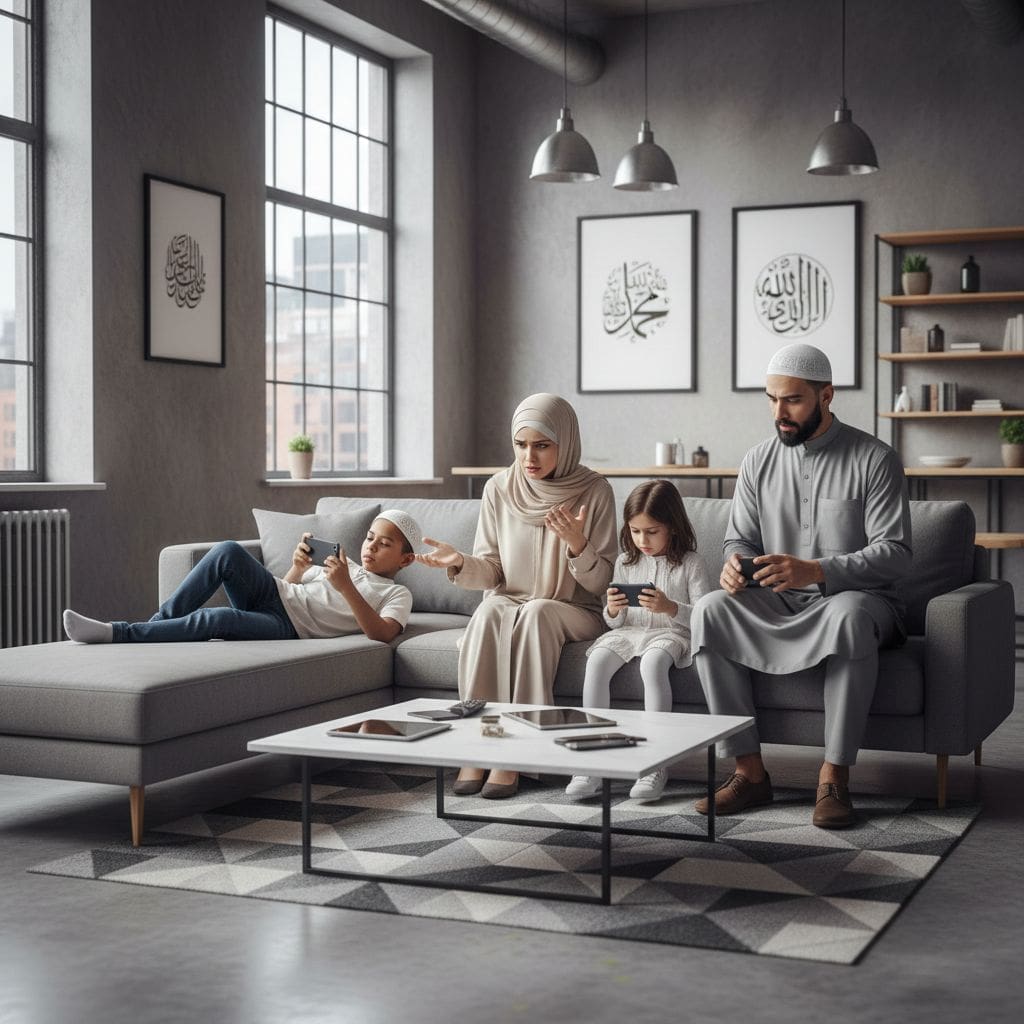
Raising Muslim children today feels harder than ever. With screens everywhere, shrinking attention spans, and constant digital stimulation, many parents search for answers using phrases like raising Muslim kids, Islamic parenting, Muslim children and screen time, and how to teach Islam to kids. Google Trends shows a sharp rise in concerns around digital distraction, faith identity, and Islamic education for children—especially among Muslim families living in urban cities.
But while most parents focus on limiting distractions, many miss what truly shapes a child’s connection to Islam.
The Reality of a Distracted Childhood
Research from Common Sense Media shows that children aged 8–12 spend an average of 5 hours a day on screens, while teens average more than 7 hours daily. Attention spans are shrinking, and constant stimulation makes reflection and focus harder—two qualities essential for spiritual growth.
Islam, however, places strong emphasis on presence and mindfulness. Allah says:
“Successful indeed are the believers—those who are humble in their prayer.” (Qur’an 23:1–2)
Humility and focus are learned skills. Without guidance, children raised in a distracted environment struggle to develop them naturally.
What Many Parents Get Wrong
Many parents respond by forcing religious routines – long lectures, memorization without understanding, or strict rules without explanation. Yet educational research shows that force-based learning reduces intrinsic motivation by over 60% in children.

The Prophet Muhammad ﷺ modeled a different approach. He was gentle, patient, and deeply aware of children’s emotional needs. Anas ibn Malik (رضي الله عنه) said:
“I served the Prophet for ten years, and he never said ‘uff’ to me.” (Bukhari)
This prophetic method reminds parents that connection comes before correction.
The Missing Piece: Structured, Meaningful Islamic Learning
What most parents are missing isn’t discipline—it’s structure. Children need a clear, age-appropriate system for learning Islam, just as they do for school subjects.
Searches for Islamic education for kids, Islamic studies for children, and how to raise Muslim kids in the West are rising because parents recognize this gap. Random lessons at home, mixed with social media exposure, can’t compete with the consistency of a structured learning path.
When Islamic learning is organized, engaging, and relevant, children begin to see Islam as part of who they are—not just another rule.
Teaching Islam the Way the Prophet ﷺ Taught
Islamic teachings were revealed gradually over 23 years. This gradual method is a powerful parenting lesson. Allah says:
“And We have spaced it gradually so that you may recite it to the people at intervals.” (Qur’an 17:106)
Children learn best when Islamic values are introduced step by step, with explanation and reflection. Studies in child development confirm that structured learning improves retention by up to 50% compared to unplanned instruction.

Building Focus in a Noisy World:
To raise grounded Muslim children, parents must prioritize:
- Consistent Islamic routines
- Meaningful conversations, not just commands
- Safe spaces for questions and curiosity
- Structured Islamic studies that grow with the child
Islam doesn’t ask parents to fight distraction alone—it offers a framework of balance, mercy, and intentional teaching.
In a world full of noise, Muslim children don’t need more pressure. They need clarity, consistency, and connection. When parents shift from controlling distractions to building purposeful learning, they raise children who don’t just practice Islam—but understand and love it.
Explore Happy Muslims Boat’s Online Islamic Course for Kids.