
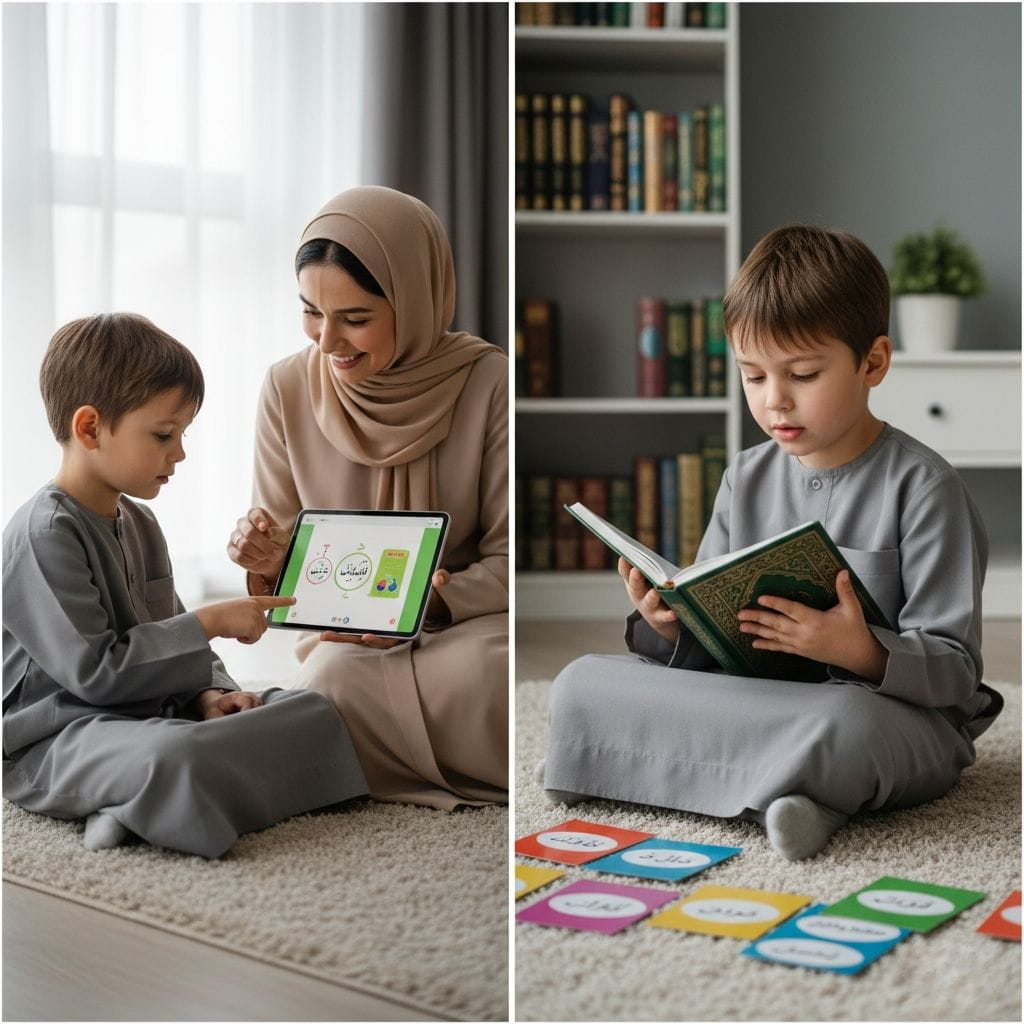
The Qur’an teaches us to seek knowledge: “Rabbi zidni ‘ilma” – “My Lord, increase me in knowledge.” (Qur’an 20:114). At the same time, modern parents face a new classroom: phones, tablets and streaming.
Research shows that screens change how children pay attention, learn, and remember. Below are practical, evidence-based strategies you can use to teach Islam and the Qur’an to children in today’s digital environment.
The challenge — what research says
Children and adolescents spend a lot of time on screens; some national data report averages of several hours a day for school-age children. This widespread exposure has been linked in child development studies to more attention difficulties and, for very young children, to weaker language outcomes when screen use displaces talk and play. (AACAP)
Strategy 1 — Make learning active, not passive
Educational psychology and recent meta-analyses show that active learning (questions, practice, discussion) improves retention and comprehension more than passive watching. Turn short video or audio lessons about a Qur’anic story into interactive moments: pause and ask a reflective question, have the child rephrase a verse in their own words, or do a two-minute role play. Active learning increases engagement and motivation — and it’s simple for parents to do. (ScienceDirect)
Strategy 2 — Use spaced, short sessions for memorisation
Research on the spacing effect and spaced repetition is clear: distributed practice beats “massed” cramming for long-term memory. For Qur’an memorisation, short daily sessions (10–15 minutes) spaced over weeks produce much better retention than a single long session. Turn one ayah into a daily 5-minute review, then expand slowly. This is an evidence-based approach grounded in cognitive science. (PMC)
Strategy 3 — Limit passive screen time and use co-viewing wisely
Studies suggest that co-viewing or guided use (parent present, discussing content) reduces some negative effects of screens and supports language and moral learning. When a child watches a religious video, watch with them and discuss the message, connect it to Qur’anic verses and Prophetic guidance like the hadith: “Seeking knowledge is obligatory upon every Muslim.” This models reflection, not mere consumption. (PMC)
Strategy 4 — Prioritise offline routines that build faith
Child development studies emphasize talk, play, and unstructured time for social and moral growth. Build short, regular routines: Quran before playtime, a nightly dua discussion, or a family hadith talk at dinner. These routines make faith part of daily life and reduce the “all-screen” reflex that crowds out learning. (PMC)
Strategy 5 — Monitor and adapt with gentle limits
Practical, research-informed parental mediation (rules, co-use, discussion) is most effective when it’s consistent and explained gently. Set clear limits on recreational screen time, replace some screen hours with outdoor or reading time, and explain why — linking the limits to Islamic values like balance and self-discipline.
Closing note
Teaching Islam in a screen-filled world is possible and urgent. Use research-backed methods like active learning, spaced practice, co-viewing, and consistent routines to help children internalise faith, not just consume content. With small, daily changes, parents can make the Qur’an and Islamic character more compelling than any app.
Explore our Beginner-friendly Kids Islamic Course – this course is animation-based, and most loved by our community members.